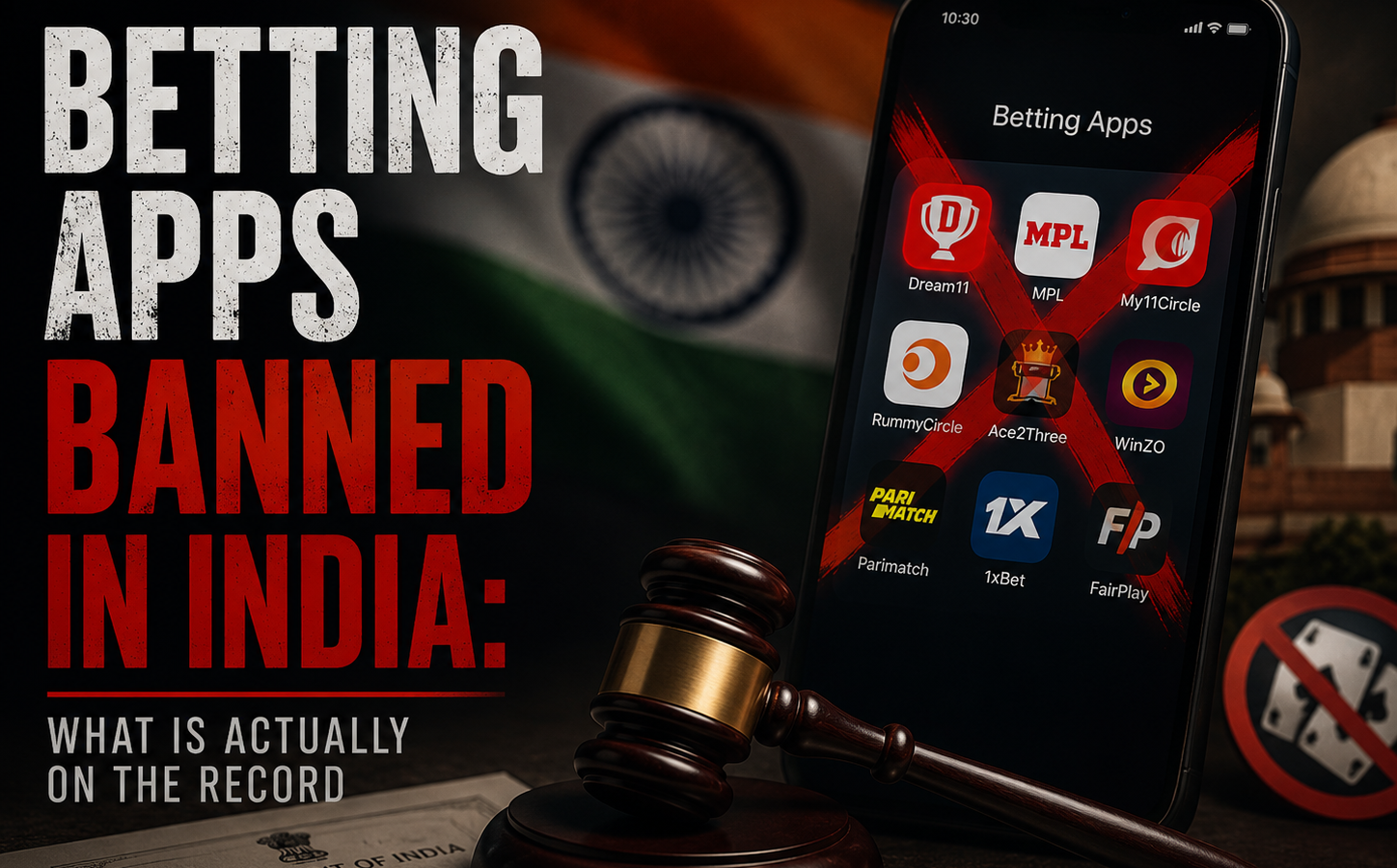
Search for a list of betting apps banned in India and you will find a dozen pages offering one. Twenty-five apps. Fifty apps. Confident tables with tick marks and dates. Almost all of them are published by sites that make money sending readers to betting platforms, and almost none of them cite a government source, because there isn’t one to cite.
The Government of India does not publish a consolidated public list of blocked betting apps. Blocking orders under Section 69A of the IT Act are, as a rule, confidential. What exists in the public record is a running total, a handful of named enforcement actions, and a great deal of inference.
So this is not a list. It is an account of what is actually on the record, where the numbers come from, why a definitive list is not obtainable by anyone — including the people selling you one — and what that means if you are trying to work out whether a particular app is legal. The short version of that last part is that it does not matter whether your app appears on a list, and the reason why is below.
Contents
- What is on the record
- Why there is no official list
- The platforms actually named in enforcement actions
- Why “is this app on the banned list” is the wrong question
- Mirrors, clones and why blocking does not stick
- The strangest blocking order of the year
- How to read the lists you will find elsewhere
- What to actually do
- Questions people ask
What is on the record
| URLs blocked or actioned | 8,376, as of 28 March 2026 |
| Source | MeitY, answering an unstarred question in the Lok Sabha, 1 April 2026 |
| Of those, post-Act | More than 4,800, following the Online Gaming Act, 2025 |
| Blocked before IPL 2026 | Around 300 sites and apps, in a pre-season sweep |
| Earlier tranche | 22 apps and sites blocked in November 2023 at the Enforcement Directorate’s request, including Mahadev Book |
| Legal basis | Section 69A, Information Technology Act, 2000 — plus the Online Gaming Act, 2025 for offences |
| Published list of names | None |
That distinction in the caption is the one most secondary coverage loses. “8,376 blocked” reads as though 8,376 distinct betting operations have been shut down. It does not mean that. A single persistent operator cycling through mirror domains can account for a long run of those entries by itself, which is also why the number keeps climbing while the underlying problem does not visibly shrink.
Why there is no official list
Blocking under Section 69A runs through a confidential process. The rules made under it treat the requests and the resulting orders as confidential, and the government has consistently declined to publish them — a position that has been litigated, criticised by transparency researchers, and not materially changed.
The practical consequence is that the public record is made of fragments: aggregate counts given in parliamentary answers, press releases about specific operations, court filings, and what intermediaries choose to disclose when they act on an order. Nobody outside the process holds the whole list, and a site presenting one as authoritative is presenting something it cannot have.
The platforms actually named in enforcement actions
A small number of platforms are on the record because a specific, documented action named them. These are worth setting out precisely, because precision is the thing missing from the lists elsewhere.
- Mahadev Book — among 22 betting apps and sites blocked by MeitY in November 2023 on the Enforcement Directorate’s request, in what became one of the largest illegal betting investigations India has run.
- 1xBet — an unlicensed offshore operator, named in blocking orders. In March 2026 the ED attached roughly ₹18.10 crore in assets tied to its Indian operation, in an investigation tracing deposits through proxy accounts and crypto rails. It had separately drawn an FIR from Bengaluru cyber police in early 2025 over unlicensed streaming of Champions Trophy coverage.
- Parimatch, Betway and Fun88 — offshore operators repeatedly reported as subject to Indian blocking orders in coverage of the post-Act sweeps.
Beyond these, naming becomes guesswork. Where a report says an app is blocked without pointing to an order, a press release or a filing, treat it as unverified — including where that report is confident and specific. Confidence is cheap.
Why “is this app on the banned list” is the wrong question
Here is the thing that makes the whole list-hunting exercise pointless.
Under the Online Gaming Act, 2025, online money games are prohibited as a class. The prohibition attaches to what the service is — you pay to play, you expect to win money — not to whether a particular app has yet been named in a blocking order. Blocking is an enforcement step taken against something already illegal. It is not the thing that makes it illegal.
So an app that has not been blocked yet is not therefore permitted. It is an illegal service that enforcement has not reached. A new offshore platform launched this morning is in exactly the same legal position as 1xBet, and will be in the same position tomorrow, whether or not it ever appears on anyone’s list.
The lists get this backwards, and the inversion is not accidental. A page structured as “these 25 are banned” invites the reading that the ones absent from it are fine — which is precisely the impression a site earning affiliate commissions on the unlisted ones benefits from.
Mirrors, clones and why blocking does not stick
A Section 69A block instructs intermediaries to make a resource unreachable — typically ISPs, at the DNS level. Two things follow, and both are well understood by the operators.
The first is that a blocked domain is replaced. Offshore betting operations run mirror infrastructure as standard, and a block on one domain is answered with a near-identical replacement, announced to existing users through the channels the block does not touch — Telegram groups, WhatsApp, SMS, affiliate networks. The turnaround is measured in days. We cover those recruitment channels, and the payment machinery behind them, in how offshore betting apps trap Indian users.
The second is that a DNS-level block is trivially circumvented by anyone willing to use a VPN, which the operators actively instruct users to do.
The evidence suggests this is not a marginal leak. A CUTS International survey in Delhi NCR in December 2025 found self-reported use of offshore betting platforms rising after the ban rather than falling — from 68.3% to 82%, with daily access sharply up. That is one metro and self-reported data, and it should not be read as a national figure; but it points the same way as traffic estimates and as the persistence of offshore betting advertising. The blocking regime has been considerably better at removing legal, taxed, domestic operators from the market than at removing illegal offshore ones.
The strangest blocking order of the year
In May 2026, MeitY blocked Gamban — a piece of software whose entire function is to block gambling sites for people trying to stop — under Section 69A, for three years. No reasons were published.
It is possible there is an explanation that makes sense; the confidentiality of the process means nobody outside it can say. What can be said is that it is a precise illustration of the transparency problem. A regime that cannot be examined produces outcomes that cannot be explained, and in this instance the tool taken offline was one used by people trying to get away from exactly the platforms the regime exists to suppress.
How to read the lists you will find elsewhere
Four tells, in rough order of how reliably they identify a page not worth trusting.
- It recommends alternatives. A page listing banned apps and then suggesting “safe” or “legal” ones to use instead is an advertisement. Since the Act there is no lawful online money-gaming alternative in India, so the recommendation is either false or is promoting another illegal operator — and promoting one is itself an offence carrying up to two years’ imprisonment.
- The count is suspiciously round and the sources are absent. “25 banned apps” with no order number, no press release and no filing is a number someone arrived at by reading other list pages.
- It carries tracking links. Check where the outbound links go. Affiliate parameters on a consumer-protection article tell you what the article is for.
- It is dated but not updated. “2026 Updated List” in a title is a headline, not a maintenance commitment.
What to actually do
If the question behind your search was whether a specific app is safe to use, the list was never going to answer it. The useful questions are simpler.
Does it take your money and offer money back? Then it is an online money game and it is prohibited, whatever it is called and whether or not it has been blocked.
Do you have a balance on one? Stop adding to it and try to withdraw now. Payment facilitation is itself an offence since May 2026, banks and processors have been closing these channels, and the common failure is not dramatic — withdrawals simply sit pending until the route out is gone. There is no Indian regulator to appeal to and no realistic way to enforce against an operator incorporated offshore.
Has it stopped being a choice? Tele-MANAS, the national mental health helpline, is free and available 24×7 in multiple languages on 14416. Behavioural addiction is within its remit.
This article states the position as of August 2026. The aggregate figures come from parliamentary answers and will be superseded; the legal position described in our guide to the law is the stable part.
Questions people ask
Is there an official list of betting apps banned in India?
No. Blocking orders under Section 69A of the IT Act are confidential and are not published as a consolidated list. What is public is aggregate counts given in Parliament, plus individual platforms named in specific press releases, filings or court records.
How many betting sites has India blocked?
8,376 URLs as of 28 March 2026, per MeitY’s answer in the Lok Sabha on 1 April 2026, with more than 4,800 of those following the Online Gaming Act, 2025. That is a count of URLs, not of distinct platforms — mirrors and clone domains inflate it substantially.
If an app is not on any banned list, is it legal?
No. The Online Gaming Act prohibits online money games as a category. An app that has not yet been blocked is an illegal service that enforcement has not reached, not a permitted one.
Why do banned apps still work?
Blocks are applied at the DNS level by ISPs. Operators run mirror domains and replace a blocked one within days, and a VPN bypasses the block entirely. Neither changes the legal position or restores any protection for your money.
What was the Mahadev Book case?
An illegal betting network investigated by the Enforcement Directorate, and among 22 apps and sites MeitY blocked in November 2023 at the ED’s request. It remains one of the largest illegal betting investigations conducted in India.
Are Dream11 and MPL on the banned list?
No. Neither was blocked. Both are Indian companies that complied with the Act by shutting down their paid contests — Dream11 in August 2025 — and continuing in free-to-play form. Compliance and blocking are different things.