For a decade, Dream11’s existence rested on a single sentence that Indian courts had been persuaded to accept: picking a fantasy cricket XI is a game of skill, and a game of skill is not gambling. Everything was built on it — the ₹6,384 crore of revenue, the eight-billion-dollar valuation, the logo on the Indian cricket team’s shirt, the 250 million registered users. The company won that argument in court after court, against state government after state government, for ten years.
In August 2025 Parliament made the argument irrelevant, with the Online Gaming Act, 2025. Nine months later the Supreme Court made it irrelevant a second time, for tax. Dream11 had not lost the skill debate. The debate had simply stopped being the thing that decided anything.
Is Dream11 banned in India? Not exactly — and the real answer is stranger than a ban. This is what happened to India’s largest gaming company, and to the industry around it, across eighteen months — and what the company that remains actually looks like.
Contents
- Ninety-five per cent, overnight
- The jersey
- The layoffs that did not happen
- What Dream11 3.0 actually is
- The rest of the industry
- How bad was it — and whose numbers are those
- The second blow: the Supreme Court and the tax
- Every phone a gambling house
- What is still open
- How to read it
- Questions people ask
Ninety-five per cent, overnight
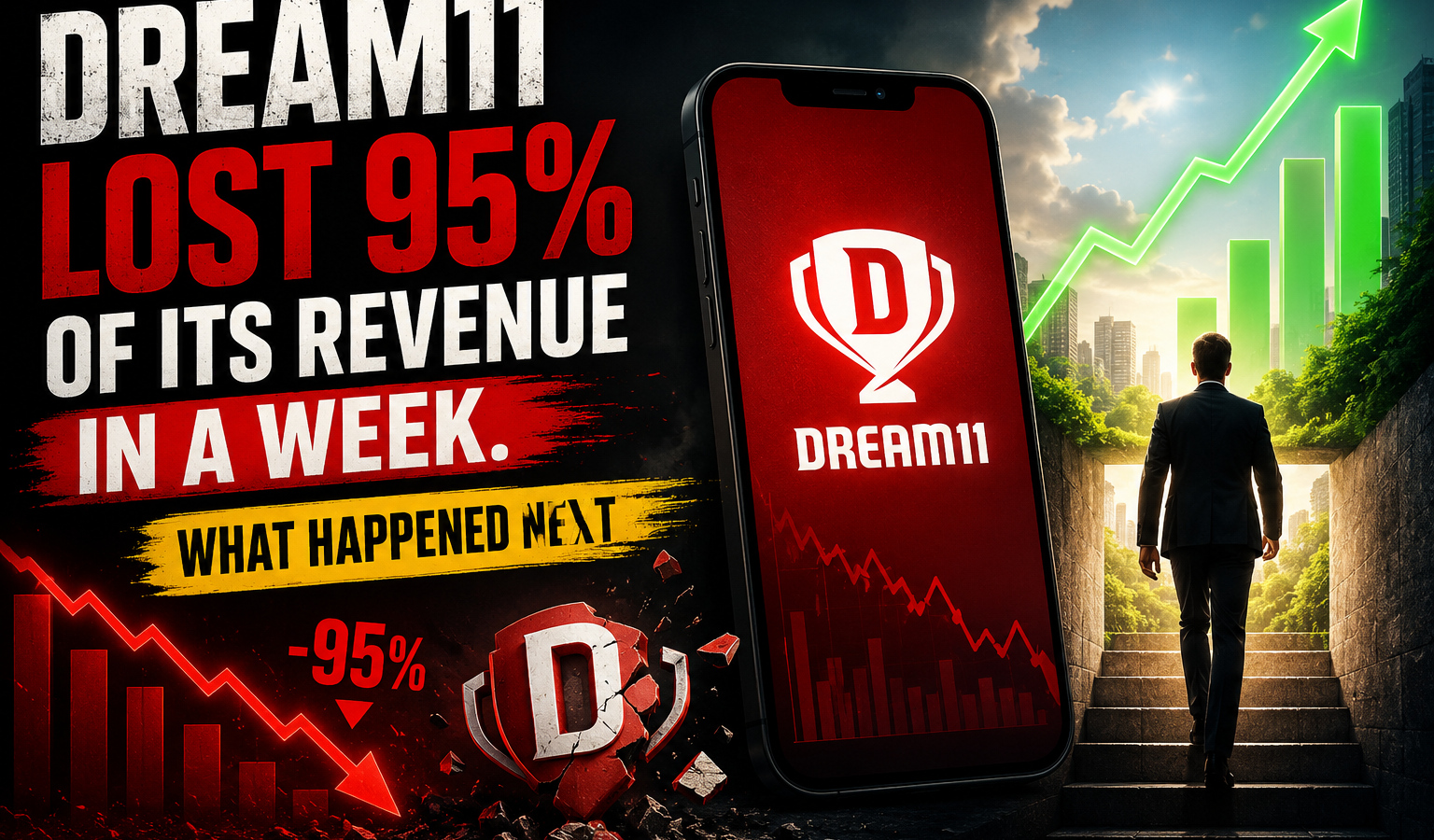
Parliament passed the Promotion and Regulation of Online Gaming Act on 21 August 2025. It received Presidential assent the following day. Dream11 discontinued paid contests within days and told users to withdraw their balances.
There was no transition. Paid contests were reported to account for roughly 95% of Dream Sports’ revenue and effectively all of its profit. Entry fees and cash prizes were the product; the free version was the funnel. In the space of a week the company went from India’s most profitable gaming business to one with a very large audience and almost no way to charge it.
| Company | Dream Sports (parent of Dream11) |
| Founded | 2008, by Harsh Jain and Bhavit Sheth |
| Operating revenue, FY23 | ₹6,384.49 crore, up from ₹3,841 crore in FY22 |
| Peak valuation | Around $8 billion |
| Registered users | More than 250 million |
| Share of revenue from paid contests | ~95%, and effectively 100% of profit |
| Paid contests ended | August 2025, within days of the Act passing |
| BCCI title sponsorship | ₹358 crore, surrendered |
| Business units after restructuring | Eight, from December 2025 |
The jersey
The most visible casualty was a shirt.
Dream11 held the title sponsorship of the Indian cricket team — a ₹358 crore deal with the BCCI — and gave it up. India went into the Asia Cup in September 2025 without a shirt sponsor, which is how a change in gaming law became something several hundred million people looked at directly.
It was also the clearest statement of how thoroughly fantasy sports had embedded itself in Indian cricket. The sport’s governing body had been taking title money from a company whose revenue came from contests on that sport’s own matches, and when the law removed the revenue, the sponsorship went with it inside a fortnight.
The layoffs that did not happen
Harsh Jain’s response to losing 95% of revenue was to rule out redundancies. “Talent is our most important asset,” he said, and — more pointedly — that if the company ever needed layoffs, that is the point at which it should consider shutting down instead.
The company held to that in the narrow sense. It did not conduct layoffs. What it did was restructure: in December 2025 Dream Sports split into eight independent business units — Dream11, FanCode, DreamSetGo, Dream Cricket, Dream Sports AI, Dream Money, Dream Horizon and the Dream Sports Foundation — and moved staff into them, redeploying around 500 engineers across the group.
Attrition then did some of the work redundancies would have. More than 100 staff left after the reassignment, roughly 15% of the 700 or so who were moved. Being reassigned from the profitable core of a company to a startup-style unit inside it is not the same as being made redundant, and it is not nothing either.
Still, set against Gameskraft cutting 120 roles and Hike shutting its Rush platform after cutting over 100, Dream Sports’ handling stands out in the sector. It had the balance sheet to absorb the shock, which most of its competitors did not.
What Dream11 3.0 actually is
The company calls the new model Dream11 3.0. Stripped of the framing, it is a free-to-play fantasy sports product monetised by advertising and sponsorship, with global expansion and AI attached as growth stories.
The asset it is built on is real: 250 million registered users, overwhelmingly young, male and cricket-obsessed, is one of the most sharply defined audiences in Indian consumer internet. Swiggy, Astrotalk and Tata Neu signed on as advertising partners early.
The problem is arithmetic. Indian digital advertising monetises a user at a small fraction of what a paying fantasy contestant was worth, and engagement without stakes is not the same engagement — the free contest was compelling largely because it advertised the paid one. A business can be built here. It is not a business the size of the one that was lost, and the eight-unit restructuring reads as an acknowledgement of that: the group is spreading its bets across sports commerce, media, travel and financial services rather than trying to rebuild the old profit pool in the same place.
The rest of the industry
Dream11 was the largest company affected but not the worst affected. It had other businesses. Most did not.
- Mobile Premier League wound down real-money operations on the same timetable.
- Gameskraft, whose RummyCulture had already been at the centre of the GST litigation, cut 120 roles.
- Hike shut Rush entirely, with more than 100 jobs going.
- Zupee, Probo, WinZO and Games24x7 all made significant cuts or exited real-money formats.
- PokerBaazi and the online poker and rummy operators, whose entire proposition was a skill-based money game, had nothing to pivot to.
One detail is worth holding onto, because it explains the sector’s bitterness. Much of this happened while the Act was still unnotified — passed and assented in August 2025, but not in force until 1 May 2026. Companies shut down profitable operations for the better part of a year on the basis of a statute that was not yet operative, because no board would authorise continuing to take stakes once Parliament had criminalised doing so. The damage was done by anticipated enforcement rather than actual enforcement.
How bad was it — and whose numbers are those
Figures for the collapse circulate widely and vary by more than an order of magnitude, so they are worth separating by source.
Within roughly 90 days of the Act passing, industry reporting put write-offs by listed companies at over ₹7,000 crore, total revenue losses above ₹10,000 crore, and the combined hit to the exchequer in GST, TDS and income tax at nearly ₹5,600 crore — with around 7,000 jobs gone. A separate assessment in November 2025 put sector losses above $840 million.
Much larger figures also circulate: roughly 2,000 real-money gaming startups disappearing and 250,000 jobs lost. Treat that pair with caution. It is an industry-body estimate covering the entire ecosystem — contractors, agencies, affiliates, marketing spend — rather than a count of employees on payrolls, and it comes from organisations that were lobbying against the Act. It may well capture something real about the total economic footprint. It is not the same kind of number as the 7,000, and coverage that presents them interchangeably is not being careful.
The exchequer figure is the one that deserves more attention than it gets. Real-money gaming was a substantial and rising source of GST. The Act did not move that revenue to a licensed alternative, because it created none. It removed it — and the demand it served largely migrated to offshore operators who pay no Indian tax at all.
The second blow: the Supreme Court and the tax
An industry that had already stopped trading was then handed the bill.
On 27 May 2026, a bench of Justices J B Pardiwala and R Mahadevan decided DGGI v. Gameskraft Technologies (2026 INSC 595). The Court held that online gaming platforms taking pooled stakes on uncertain outcomes supply “actionable claims” — goods under the CGST Act — that the operators are the suppliers rather than mere intermediaries, and that GST is chargeable at 28% on the full face value of player deposits, not on the platform’s commission.
Two features make it severe. It applies retrospectively. And the reasoning is the same move Parliament had made: what matters is that money is staked on an uncertain outcome, and whether the game is one of skill or chance is beside the point.
The resulting demands are enormous and reported inconsistently — figures from around ₹1 lakh crore to nearly ₹2.5 lakh crore appear in credible coverage, the spread depending on which demands are counted and over what period. Either way it exceeds what the industry earned across the years in question, which is what happens when a tax computed on turnover is applied to a business that only ever kept a commission.
The sequence matters. The companies shut down first, in anticipation of a law that had not commenced, and received a retrospective tax on the years they had already traded afterwards.
Every phone a gambling house
The same bench decided State of Tamil Nadu v. Junglee Games (2026 INSC 594) on the same day, upholding state power to regulate and prohibit online gaming.
Its most quoted passage addresses the concept of the “common gaming house”, the century-old category around which Indian gambling law was built and which assumes a physical room. The Court reasoned that when the game is on a phone, the phone is the gaming house — every handset in the country a potential one.
It is a striking image, and it is also the doctrinal hinge. Once the gaming house travels in a pocket, the old framework — territorial, premises-based, state-by-state — cannot do the work, and something national and device-agnostic replaces it. That is a fair description of the Act itself.
What is still open
The constitutional challenge to the Act itself has not been decided. A batch of petitions, led by Head Digital Works, operator of A23, is before a three-judge bench headed by Chief Justice Surya Kant. The central question is whether a blanket prohibition — extending to rummy and poker, games Indian courts spent decades holding to be games of skill — is a proportionate restriction on the right to carry on a trade or business.
The petitioners’ difficulty is that the Gameskraft reasoning has already run through the same terrain from the tax side and concluded that staking money on an uncertain outcome is the operative fact, with skill immaterial. That is not binding on the constitutional question. It is not an encouraging signal either.
Even a successful challenge would arrive late for most of the sector. The companies are already shut, the staff already dispersed, the users already gone — a good many of them to platforms operating outside Indian jurisdiction entirely.
How to read it
The case for the Act is genuine and should not be waved away. Real-money gaming in India produced documented harm — household debt, addiction, suicides — on a scale that the industry’s own responsible-gaming measures plainly were not containing. A government looking at that evidence and deciding the format should not exist is making a defensible choice, and the skill-versus-chance distinction had become a lawyer’s device rather than a description of anything a user experienced.
The case against is not really about that. It is that prohibition without a licensed alternative does not remove demand; it relocates it. What has demonstrably been removed is the part of the market that was Indian, taxed, KYC’d, reachable by regulators and capable of being made to answer for harm. What has grown is the part that is offshore, untaxed, unreachable, and — as the enforcement record shows — running its payments through mule accounts belonging to people who do not know they are involved.
Whether that is a transitional cost of a policy that eventually works, or the steady state of one that will not, is the open question. A year in, the evidence available leans towards the second, and the counter-evidence is thin.
This article states the position as of August 2026. The constitutional challenge is undecided and the tax demands are being worked through; both will move.
Questions people ask
Is Dream11 banned in India?
No. The app operates and was never blocked. Its paid contests are prohibited — Dream11 ended them in August 2025 to comply with the Online Gaming Act, and now runs free-to-play fantasy sports with no entry fees and no cash prizes.
Can I still win money on Dream11?
No. Cash prizes ended with paid contests in August 2025. Contests continue in free-to-play form, and users were asked to withdraw their balances at the time.
Why was fantasy sports banned when it is a game of skill?
Because the Act made the distinction irrelevant. It prohibits games played for money with the expectation of winning money, whether the outcome turns on skill, chance or both. The Supreme Court reached the same conclusion for GST in May 2026: what matters is that money is staked on an uncertain outcome.
How much revenue did Dream11 lose?
Around 95% of it, and effectively all its profit. Dream Sports reported operating revenue of ₹6,384.49 crore in FY23, the last full year before the ban, almost all of it from paid contests.
Did Dream11 lay people off?
No formal layoffs — Harsh Jain ruled them out publicly. The company restructured into eight business units in December 2025 and redeployed staff, including about 500 engineers. More than 100 people subsequently left, roughly 15% of those reassigned.
What happened to the Team India sponsorship?
Dream11 surrendered its ₹358 crore BCCI title sponsorship after the ban, and India played the Asia Cup in September 2025 without a shirt sponsor.
What did the Supreme Court decide in May 2026?
In DGGI v. Gameskraft it upheld 28% GST on the full face value of player deposits, applied retrospectively, holding that skill versus chance is immaterial where money is staked. In State of Tamil Nadu v. Junglee Games, decided the same day, it upheld state powers over online gaming. The constitutional challenge to the Online Gaming Act itself is separate and still pending.