For about thirty years, the question is online betting legal in India? had only a lawyer’s answer. Betting was a state subject, the governing statute was drafted in 1867, and everything turned on whether a particular game was one of skill or one of chance — a line the courts had drawn around horse racing and rummy, and which every fantasy sports company in India then drove a fleet of trucks through. The answer changed depending on which state you were sitting in and which lawyer you asked.
That is over. The Promotion and Regulation of Online Gaming Act, 2025 did not redraw the skill-and-chance line. It abolished it. If you pay money to play and you stand to win money, the game is banned — whether winning takes skill, luck, or both.
This piece sets out what the law actually says, who it punishes and who it does not, what is still legal, and where the gap between the statute and the situation on the ground is widest. The law is new enough that parts of it are still moving; those parts are marked.
Contents
- The short answer
- The law in dates
- Three categories, one of them banned
- Why the skill-versus-chance argument stopped working
- Are you breaking the law by placing a bet?
- What the penalties actually are
- What is still legal
- What happened to Dream11 and the Indian industry
- The offshore problem: blocked, and still growing
- If your money is sitting on an offshore site
- What is still unsettled
- Questions people ask
The short answer
No. Online betting for money is illegal across India, and has been since the Act took effect. There is no licensed route, no state where it is permitted online, and no distinction that rescues fantasy sports, poker or rummy from the ban.
The important qualifier, and the one most people are actually asking about: the Act’s criminal penalties are aimed at the people who run, advertise and bankroll these platforms, not at the person placing the bet. That is covered in detail below, because it is where most of the confusion sits.
The law in dates
| The statute | The Promotion and Regulation of Online Gaming Act, 2025 |
| Passed | Both Houses, August 2025 |
| Presidential assent | 22 August 2025 |
| The rules | The Promotion and Regulation of Online Gaming Rules, 2026 |
| Rules notified | 22 April 2026, by MeitY |
| Rules in force | 1 May 2026 |
| The regulator | Online Gaming Authority of India (OGAI), constituted 22 April 2026 |
| What is banned | All online money games — skill, chance or any combination |
| Also banned | Advertising them, and processing payments for them |
| What is permitted | Online social games and e-sports, under a registration framework |
| Replaces | The state-by-state patchwork built on the Public Gambling Act, 1867 |
Three categories, one of them banned
The framework sorts every online game into one of three boxes. Almost every practical question about legality resolves to working out which box a game sits in.
Online money games are games played by paying a fee, deposit or stake, where the player expects to win money or something of monetary value in return. These are prohibited outright. The category is deliberately drawn wide: it does not care whether the outcome turns on skill, on chance, or on a mixture, and it captures stakes that are not strictly cash.
Online social games are games offered for entertainment, recreation or skill-building, with no stake and no expectation of a monetary return. These are permitted. A subscription or a one-time access fee does not by itself push a game into the banned category — the test is whether the money you pay is a stake on an outcome, not whether money changes hands at all.
E-sports are permitted and, notably, actively promoted — the word sits in the title of the Act for a reason. They fall under a registration framework operated by OGAI, with recognition available to platforms that seek it.
Why the skill-versus-chance argument stopped working
This is the single most consequential thing in the Act, and it is the part most older articles get wrong because they were written before it.
The entire legal edifice of Indian real-money gaming rested on one proposition: that a game of skill is not gambling. Courts had accepted that for horse racing and for rummy, and the fantasy sports industry built itself on the argument that picking a cricket XI was a skilled exercise rather than a wager. State governments disagreed at intervals, litigation followed, and the answer genuinely varied by jurisdiction.
The Act does not resolve that argument. It makes it irrelevant. Prohibition attaches to the structure of the transaction — money in, monetary reward expected out — and not to the nature of the game wrapped around it. A platform can now demonstrate to a court’s satisfaction that its game is 100% skill and be no less illegal for it.
This is why an industry that had spent a decade winning the skill argument shut down within weeks of losing this one.
Are you breaking the law by placing a bet?
The Act’s offence provisions are directed at the supply side. Read them in order and the target is consistent:
- Offering an online money gaming service
- Advertising or promoting one, in any medium
- Facilitating financial transactions for one — which is how banks and payment processors were pulled into scope
Placing a bet as an individual player is not listed as an offence carrying these penalties. The design intent is visible in the enforcement record too: what the state has actually done is block platforms, attach operators’ assets and pursue payment channels, not prosecute players.
Two cautions against reading that as a green light. First, “not the target of this Act’s penalties” is not the same as “protected” — money moving to an offshore operator can still draw scrutiny under foreign exchange and money laundering law, which are separate statutes with their own logic. Second, and more practically, the absence of a criminal risk to you does nothing about the commercial risk, which is considerable and falls on you entirely.
If you need certainty about your own exposure, that is a question for a lawyer looking at your facts, not for an article.
What the penalties actually are
| Conduct | First offence | Repeat |
| Offering an online money gaming service | Up to 3 years, and/or up to ₹1 crore | 3–5 years, plus ₹1–2 crore |
| Advertising or promoting one | Up to 2 years, and/or up to ₹50 lakh | Up to 3 years, plus up to ₹1 crore |
| Facilitating payments for one | Up to 3 years, and/or up to ₹1 crore | — |
The advertising penalty deserves a note of its own, because its reach is wider than operators. It bites on anyone who “makes or causes to be made” an advertisement promoting an online money game, in any form of media. On its face that extends past the platforms to the publishers, influencers and affiliates who carry their marketing — a category of exposure that did not exist before August 2025 and that a good deal of Indian betting-adjacent content has not adjusted to.
What is still legal
- Free-to-play fantasy sports. The contest survives; the entry fee and cash prize do not. This is the model Dream11 now runs on.
- E-sports. Competitive video gaming, explicitly promoted by the Act and regulated rather than banned.
- Online social and casual games, including paid ones, provided the payment is for access rather than a stake on an outcome.
- Offline and state-run gambling where a state permits it — physical casinos in Goa, Sikkim and Daman, and state lotteries, sit outside this Act, which is addressed to online games. State law governs them and is unchanged.
- Horse racing at a physical racecourse, under the relevant state’s racing legislation.
The pattern is that the Act is a law about the internet, not a general prohibition on gambling in India. It leaves the offline, state-licensed world where it found it.
What happened to Dream11 and the Indian industry
The domestic industry did not fight. It closed.
Dream11 discontinued paid contests in August 2025, within days of the Bill passing, and told users to withdraw their balances. We tell that story in full in what happened to Dream11. Paid contests were reported to account for roughly 95% of its revenue and effectively all of its profit. The company kept its user base — north of 250 million registered players — and pivoted to free-to-play, monetising through advertising and sponsorship instead.
It also gave up the ₹358 crore title sponsorship of the Indian cricket team, which is how a change in gaming law ended up visible on the front of a national jersey.
Mobile Premier League, Gameskraft, Probo and Zupee wound down real-money operations on a similar timetable. The clearest way to read the last year is that the ban worked precisely on the companies that were incorporated in India, paying Indian tax, and reachable by Indian law — and, as below, considerably less well on everyone else.
The offshore problem: blocked, and still growing
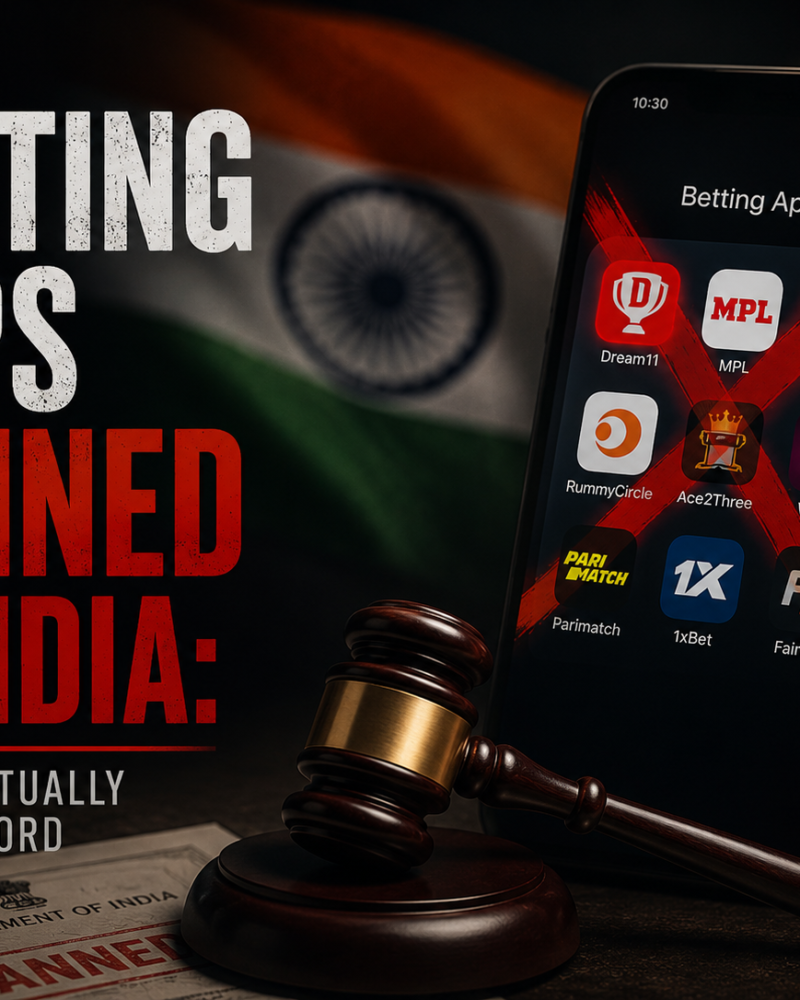
In an answer to the Lok Sabha on 1 April 2026, MeitY put the number of betting and gambling URLs blocked or actioned at 8,376 as of 28 March 2026, more than 4,800 of them after the Act came in. A handful of major offshore operators are on the record as subject to those orders — 1xBet, Parimatch, Betway and Fun88 among them — but there is no published list, and the counts that circulate elsewhere are not sourced to one. We set out what is actually verifiable in the apps named in blocking orders.
Enforcement has gone past blocking. In March 2026 the Enforcement Directorate attached assets of about ₹18.10 crore connected to 1xBet’s Indian operation, in an investigation that traced deposits through proxy bank accounts and crypto rails. 1xBet had already picked up an FIR from Bengaluru cyber police in early 2025 over unlicensed streaming of Champions Trophy coverage.
And yet the blocking is visibly leaky. A blocked domain returns as a mirror within days, and a URL block is a speed bump to anyone with a VPN. There is survey evidence that use went up rather than down after the ban: a CUTS International study in Delhi NCR in December 2025 found self-reported usage rising from 68.3% before the ban to 82% after, with daily access far higher than before. Treat those figures with care — one metro, self-reported, a sample that skews to people already inclined to answer questions about betting — but the direction is corroborated by traffic estimates and by the volume of offshore betting advertising still circulating.
The honest summary of year one is that the Act closed the regulated, taxed, domestic industry with great efficiency and pushed a good deal of the demand towards operators outside Indian jurisdiction, where the consumer protections are nil. Whether that is a transitional problem or the steady state is the open question of the next few years.
If your money is sitting on an offshore site
This is the practical part, and it is the reason the legal question matters even to someone who is unbothered by legality.
A balance on an offshore betting platform is not a deposit and it is not protected. If the operator freezes your account, voids your winnings, or simply stops responding, there is no Indian regulator to complain to, no ombudsman, and no realistic prospect of enforcing a judgment against a company incorporated in Curaçao or Cyprus. The platform is unlawful here, which also means the contract you have with it is not one an Indian court will help you enforce.
The payment side has become the sharper problem since May 2026. With payment facilitation itself an offence, banks and processors have grown aggressive about identifying and cutting these flows. The mechanics of how these platforms move money — and why that can freeze your bank account — are set out in how offshore betting apps trap Indian users. The failure mode users report is not a dramatic one: deposits stop clearing, withdrawals sit pending indefinitely, and the balance is stranded on a platform that no longer has a legal way to pay it out. Accounts have also been frozen at the bank’s end while transactions are examined.
If you are carrying a balance, the sensible move is to stop adding to it and try to withdraw now rather than later, on the assumption that the channels get narrower rather than wider from here.
Separately: if betting has stopped being a choice, the national mental health helpline Tele-MANAS is free, 24×7, in multiple languages, on 14416. Behavioural addiction is within its scope.
What is still unsettled
Four things are genuinely open, and anything you read that states them confidently is overreaching.
- Constitutional challenge. Betting and gambling sit in the State List of the Seventh Schedule, and the Act is central legislation. The government’s position rests on its power over communications and inter-state commerce. A batch of petitions led by Head Digital Works is before a three-judge bench headed by Chief Justice Surya Kant, and is undecided. Note the signal from an adjacent case: on 27 May 2026 the Supreme Court held in DGGI v. Gameskraft (2026 INSC 595) that 28% GST applies to the full face value of player deposits, retrospectively, reasoning that skill versus chance is immaterial where money is staked — the same move the Act makes. That is not binding on the constitutional question, but it is not an encouraging sign for the petitioners.
- The boundary of “other stakes”. The money-game definition reaches beyond cash, which leaves live questions about in-game currencies, tokens and loot-box mechanics in games nobody thinks of as gambling.
- How far the advertising offence travels. Where exactly it lands on affiliates, review sites, influencers and platforms carrying offshore ads has not been tested in court.
- Whether enforcement can reach offshore operators at all. A year of blocking has not produced a decline in use. What the state does next — pressure on app stores, on payment rails, on ISPs — is the thing to watch.
This article states the position as of August 2026. The Rules have been in force for under four months and the Authority is new; check the dates on anything you read about this, including this.
Questions people ask
Is online betting legal in India?
No. The Promotion and Regulation of Online Gaming Act, 2025 prohibits all online money games nationwide, along with advertising them and processing payments for them. There is no licensed route and no state exemption.
Can I be arrested for using a betting app?
The Act’s penalties are directed at operators, advertisers and payment facilitators rather than individual players, and enforcement to date has followed that pattern. This is not a guarantee of immunity — foreign exchange and money laundering law are separate — and it says nothing about the risk of losing your money.
Are games of skill still allowed if money is involved?
No, and this is the central change. The Act bans money games irrespective of skill or chance. The old skill-based defence, which fantasy sports and online rummy were built on, no longer has anything to attach to.
Is Dream11 banned?
The app is not banned and still operates. Its paid contests are — Dream11 shut them in August 2025 and now runs free-to-play fantasy sports with no entry fees and no cash prizes.
Is 1xBet legal in India?
No. It is an unlicensed offshore operator, named in Indian blocking orders, and in March 2026 the Enforcement Directorate attached around ₹18.10 crore in assets tied to its Indian operations. Money held there has no legal protection in India.
Does using a VPN make it legal?
No. A VPN changes what your ISP can block, not what the law says. The prohibition attaches to the service being offered to users in India; routing around a block does not alter the legal position, and it leaves every commercial risk exactly where it was.
Are casinos in Goa and Sikkim affected?
No. This is a law about online games. Physical casinos licensed by a state, and state lotteries, are governed by state legislation that the Act leaves untouched.
Is e-sports affected by the ban?
Not adversely. E-sports is expressly recognised and promoted under the Act, with a registration framework run by the Online Gaming Authority of India. The prize money in a recognised e-sports competition is not what the money-game prohibition is aimed at.