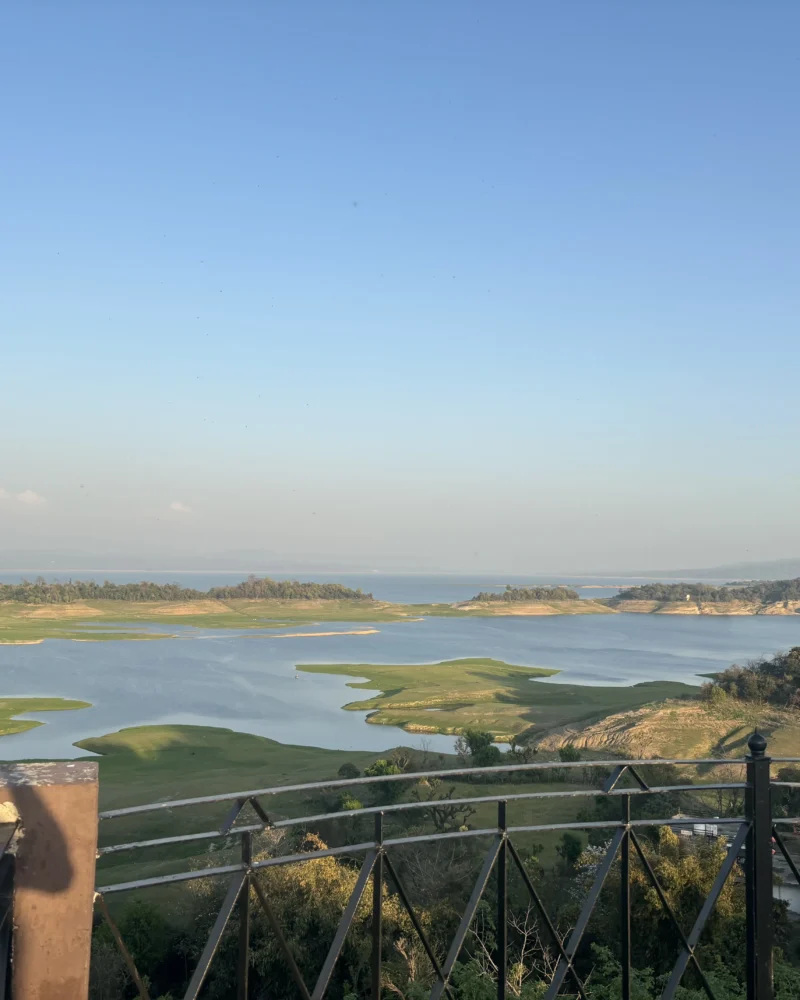
About twenty minutes out from the jetty the shore behind you has gone flat and the shore ahead has not arrived yet, and for a few minutes there is nothing on any side but water and, if the air is clean, the Dhauladhar sitting along the top of it. Then a low green line comes up out of the lake. That is Rancer Island, and there is a forest rest house on it, which is the only reason anybody stays the night in the middle of Pong Dam.
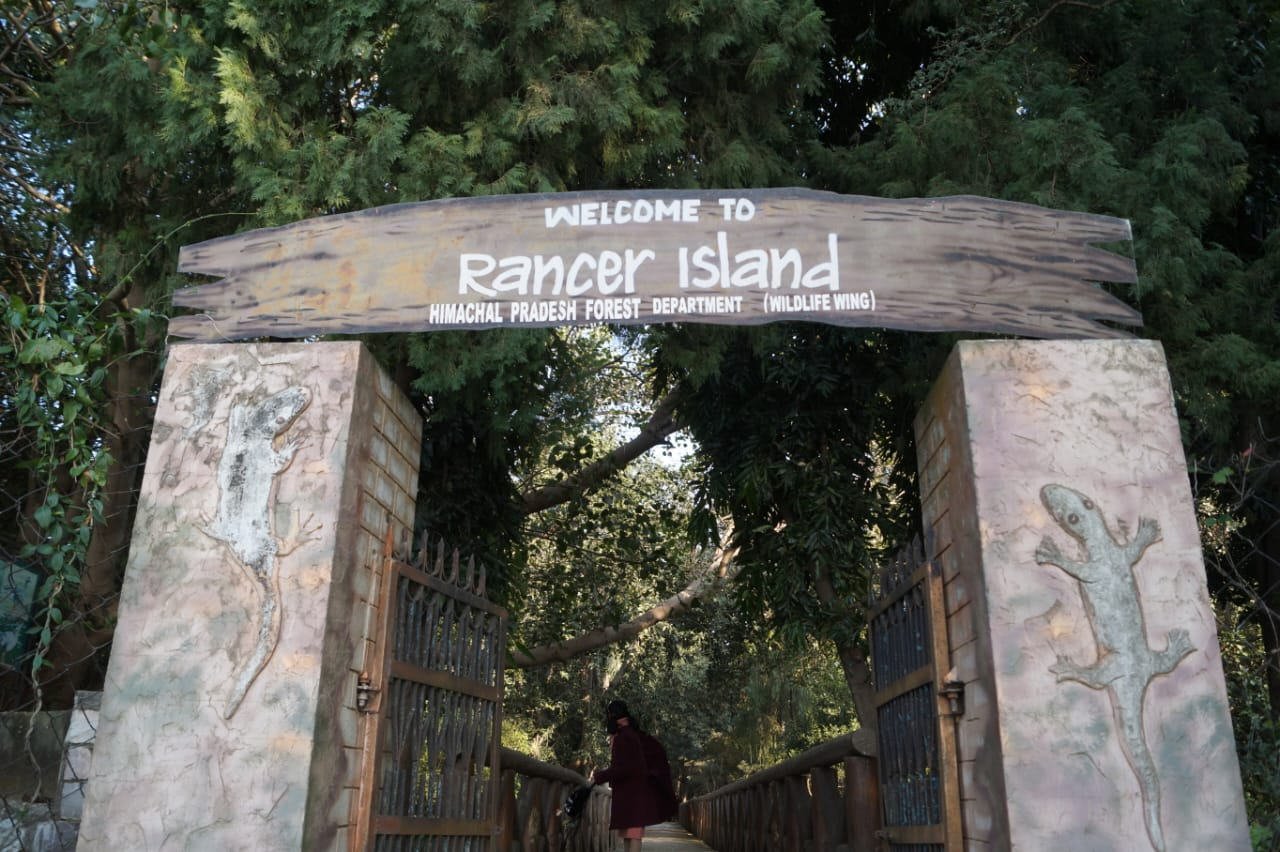
Rancer Island — you will also see it written Ranser — is the largest of the islands in Maharana Pratap Sagar, the reservoir behind the Pong Dam, in Kangra district of Himachal Pradesh. It is inside a wildlife sanctuary and a Ramsar wetland, it has no village, no shops and no road, and getting on to it means a boat.
This is not a trip report. It is an attempt to set out what is actually on the island, how the boat works, and how the Rancer Island guest house booking works — because that last part is where most plans fall over, and almost nobody writes it down straight. Anything that changes with the season, the water level or the department’s own rules is marked as such.
Contents
- Rancer Island in numbers
- Where Rancer Island is
- The lake it sits in
- How to reach Rancer Island
- The land crossing, and why not to plan around it
- Best time to visit Rancer Island
- What there is to do
- The Rancer Island guest house: what it actually is
- Rancer Island booking: how it works
- The rules that catch people out
- What to check before you go
- What to combine it with
- Questions people ask
Rancer Island in numbers
| Where | Maharana Pratap Sagar (Pong reservoir), Kangra district, Himachal Pradesh |
| What | The largest of the reservoir’s islands, inside the Pong Dam Wildlife Sanctuary |
| The other islands | Karu, Rajeli, Jattan da Kuwal, Danderh. None of them has anywhere to stay |
| Getting there | Boat. Roughly twenty minutes from the Khatiyar side; about four kilometres of water from the Nagrota Surian wetlands |
| Managed by | Himachal Pradesh Forest Department, Wildlife Wing |
| Where you sleep | A forest rest house on the island. That is the whole accommodation stock |
| Nearest airport | Gaggal (Kangra), roughly 75 km by road to the lakeside |
| Nearest major railhead | Pathankot, roughly 70 km |
| From Dharamshala | Around 55 km to the boarding points, depending on which one you use |
| Comes for | Birds, the boat ride, and the fact that there is nothing else on the island |
Where Rancer Island is
This is the lower, flatter, hotter part of Kangra — the stretch below the Dharamshala hills where the Beas spreads out and was impounded in the 1970s. The reservoir drowned a wide belt of farmland and low hills, and the tops of some of those hills are now the islands. Rancer is one of them, sitting out towards the middle of the water with the Dhauladhar along the northern horizon.
It is worth being clear about the geography, because “island in the Himalayas” sets up the wrong picture. There are no slopes on Rancer. It is a low, grassy rise a few metres above a very large body of water, with scrub, trees, marshy edges and a rest house in the middle of it. The mountains are the backdrop, forty-odd kilometres off, and in summer haze they are frequently not there at all.
The lake it sits in
Pong Dam Lake is a Ramsar site and a declared wildlife sanctuary, and it is one of the more serious birding wetlands in north India — something over four hundred species recorded, across a wide spread of families, and a winter influx of migratory birds counted in the low lakhs. Bar-headed geese are the ones people come for; the rest of the list is long and mostly waterfowl and waders.
Two consequences of that status matter to a visitor. The first is that the islands are managed by the Forest Department rather than by tourism, which is why the accommodation is a rest house and not a resort, and why access is subject to their permission rather than to a booking site. The second is that the shoreline moves. The reservoir fills through the monsoon and is drawn down through the winter and spring, so the size of the island, the length of the boat ride and which jetties are even usable all change through the year.
How to reach Rancer Island
| Leg | How |
|---|---|
| To the lake | Road. Dharamshala, Kangra town and Pathankot are the usual starting points; the last stretch to the shore is narrow and slow in places |
| Boarding points | Khatiyar, where the watersports setup and the motorboats are, and Nagrota Surian on the wetland side |
| The crossing | Motorboat, roughly twenty minutes from Khatiyar. Country boats and kayaks operate on the lake too, but the island run is a motorboat job |
| On the island | A walk from wherever the boat can get in to the rest house — across grassland, longer at low water when the boat stops further out |
| By air | Gaggal (Kangra), then road |
| By rail | Pathankot for the broad gauge. The Kangra Valley narrow-gauge line serves the district and is frequently suspended in sections — check its status before planning around it |
The thing to sort out before you leave the shore is the return. There is no scheduled service to Rancer. You are dealing with a boat operator, and if you are staying the night you need an agreed time for the pickup the next day, confirmed with the operator and with the caretaker on the island. There is no walking off, and phone signal out there is not something to depend on.
The land crossing, and why not to plan around it
In a low-water year the marshes between the Nagrota Surian wetlands and the island dry out enough to be crossed on the ground, usually for a short window around May and June. People do ride across. It is worth knowing about, and it is not worth planning a trip around.
Whether it happens at all depends on how far the reservoir has been drawn down that particular year, the window is short, and the surface it leaves behind is dried silt and marsh — bike terrain rather than car terrain, and terrain that punishes anyone who misjudges where the wet ground starts. Treat the land route as a thing that might be available when you get there, and book the trip on the assumption that you are taking a boat.
Best time to visit Rancer Island
- November to February for the birds. This is the migratory season and the reason the sanctuary exists. It is also when the air is clearest, which is when the Dhauladhar actually appears behind the water. Mornings on the lake are cold; bring more than you think.
- March and April for the compromise — still reasonable light and visibility, fewer birds, warmer boat rides.
- May and June are hot and hazy, the mountains often invisible, and the lake at its lowest. This is also the only window in which the land crossing is even a possibility.
- Monsoon fills the reservoir and greens everything, and boat operations are weather-dependent. Not a write-off, but not a season to be inflexible in.
What there is to do
Not a great deal, which is the honest answer and also the point. The island has walking paths and grassland, water on every side and a rest house. There is no market, no café, no temple, no viewpoint with a railing.
- Birds. The marshy edges of Rancer and neighbouring Karu are good for waders and warblers, and the open water around them for wintering wildfowl. Early morning is when it happens. Carry binoculars — this is not a species-in-your-face wetland, it is a scan-the-far-shore one.
- The boat ride. Genuinely the highlight for most people, and worth doing at either end of the day rather than at noon.
- Fishing. The reservoir is deep and productive and angling is an established activity here. It is regulated; ask locally about permits rather than assuming.
- Photography. The light over the water changes fast at both ends of the day, and the high ground on the mainland side gives you the island in frame from a distance.
- Sitting still. Which is what the overnight is for. If that does not appeal, the island is a two-hour visit, not a stay.
The Rancer Island guest house: what it actually is
It is a forest rest house, run by the Wildlife Wing of the state Forest Department, set in the trees a walk in from the water. Every description that calls it a guest house is using a friendlier word for the same building. Set your expectations from the category, not from the photographs.
- Basic rooms. Departmental furniture, plain bathrooms, a veranda. Functional, generally clean, not styled.
- Limited services. Power and water supply on an island in a reservoir are not the same proposition as on the mainland. Assume interruptions and carry a torch and a power bank.
- Food is arranged, not ordered. There is a caretaker and there is simple cooked food if you have asked in advance. There is no menu and no shop to correct an oversight, so tell them what you need before you cross, and carry your own water and snacks.
- Very few rooms. This is a rest house, not a hotel. The capacity of the whole island is a handful of rooms, which is why dates go and why groups struggle.
- The location is the product. Water on every side, no other buildings, no traffic, and a sky that is genuinely dark. That is what you are paying for.
Rancer Island booking: how it works
A Rancer Island guest house booking is a Himachal forest rest house booking, and it runs on the same machinery as every other FRH in the state. The steps below are the current shape of that system; rates and portal listings change, so treat the numbers as indicative and confirm them at the time.
- Start at the official portal. Forest rest house bookings go through the Ecotourism Society of Himachal Pradesh at hpecotourism.com. Look for the Kangra district and Pong Dam listings.
- If it is not listed online, go to the office. Not every rest house in the state is on the portal, and remote wildlife-wing properties are exactly the ones that tend not to be. The fallback is the DFO (Wildlife) at Dharamshala, the division that administers the Pong sanctuary, or the range office on the lakeside. A phone call establishes in five minutes what a week of refreshing a website will not.
- Book inside the window. The portal opens FRH bookings around thirty days ahead and closes them a couple of days before check-in. There is no walk-up equivalent on an island.
- Upload ID. An Aadhaar or equivalent government photo ID is submitted with the booking and checked by the caretaker on arrival. Carry the original.
- Pay in full, in advance. Forest rest house bookings are full prepayment including tax. Room rates in this system are modest — of the order of a thousand rupees a night plus GST for a standard room, with variation by property — and are revised from time to time.
- Confirm timings and the boat. Check-in and check-out at HP rest houses is generally noon. Once you have a confirmed date, get the caretaker’s number and settle the boat at both ends before you drive out.
On cancellation: the standard FRH terms refund most of the room charge if you cancel well ahead — around ninety per cent at fifteen days or more, dropping to about half in the five-to-fourteen-day band, with GST and transaction charges not returned — and nothing useful at short notice. Book dates you are actually going to use.
The rules that catch people out
- Officials come first. This is the one that ruins trips. A forest rest house exists for departmental staff and government officers on duty; tourist bookings are accommodated around that, and a confirmed reservation can be released if an official requirement lands on your dates. It is unusual, it is not unheard of, and there is no appeal. Have a mainland fallback near Nagrota Surian or Khatiyar in mind.
- You are inside a sanctuary. Forest department permission governs what you can do, where you can walk and whether the island is open at all in a given period. Restrictions during the breeding or peak migratory season are a normal thing for the department to impose.
- No fires, no smoking indoors. Standard across HP rest houses, and enforced more seriously somewhere the fire brigade would have to arrive by boat.
- Carry cash. Service or housekeeping charges payable to the caretaker on site, and the boat itself, are cash transactions. There is no card machine and no ATM on the island.
- Alcohol and loud music. Not what the property is for, and not what the department tolerates in a wildlife sanctuary. Groups looking for a party island should look elsewhere.
- Take your rubbish back. There is no collection out there. Whatever you carry in leaves with you on the boat.
What to check before you go
- That the rest house is available and open, from the portal or the DFO (Wildlife) office at Dharamshala — not from an article, this one included.
- Current rates and cancellation terms, which are revised periodically.
- Whether the sanctuary or the island has any seasonal restriction on your dates.
- The boat: which boarding point is operating at the current water level, what the crossing costs, and the exact pickup time for your return.
- Food: what the caretaker can provide, and what you therefore need to carry.
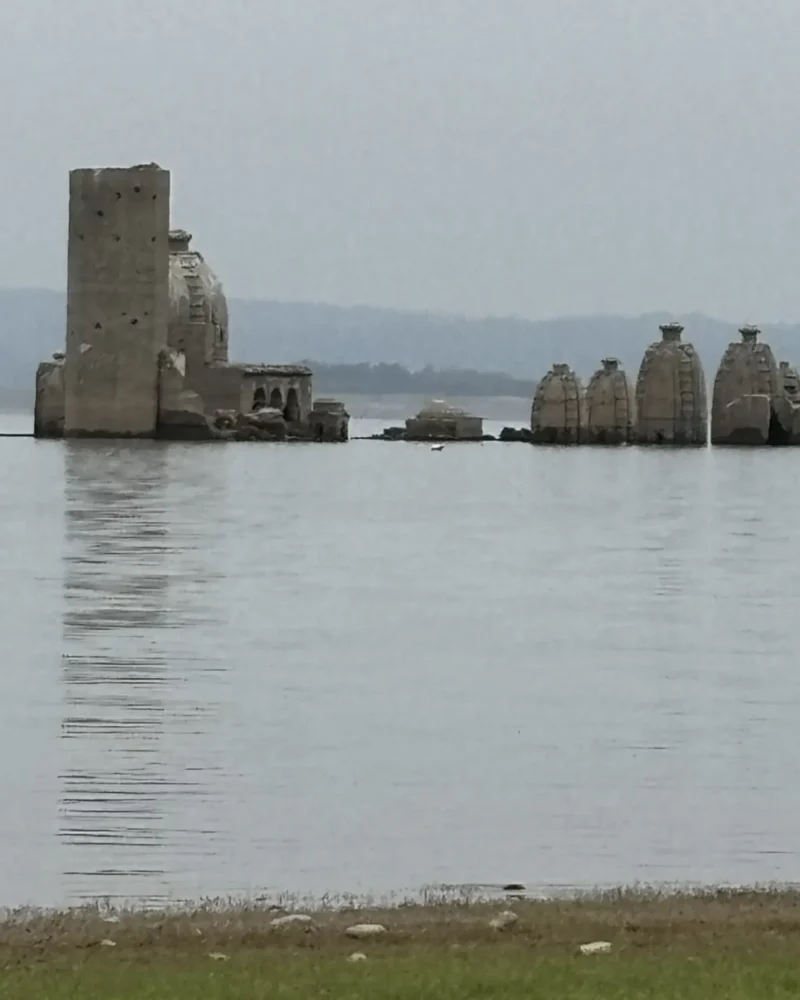
- The water level, if you also want Bathu ki Ladi on the same trip — the temples there are only above water for part of the year.
What to combine it with
Rancer rarely stands alone on an itinerary, and it should not — the drive out here is long enough that one boat ride is thin justification for it.
- Bathu ki Ladi — the medieval temple cluster in the same reservoir, which spends half the year underwater. Same lake, same boats, entirely different thing to look at.
- Masrur rock cut temples — the monolithic complex carved out of a sandstone ridge, an easy add-on from the Pong side.
- Nagrota Surian — the wetland side of the lake, the main birding stretch, and a boarding point.
- Dharamshala and the Kangra valley — the obvious base at either end of a Pong trip, and where the accommodation actually is.
Questions people ask
What is Rancer Island?
The largest island in the Pong reservoir in Kangra district, Himachal Pradesh, inside the Pong Dam Wildlife Sanctuary. Grassland and trees, a forest rest house, and no permanent population.
Is Rancer Island open to tourists?
Yes, for boating, birdwatching and overnight stays at the rest house — subject to Forest Department permission, which can be withheld seasonally. It is not an unconditional right of access.
How do I get to Rancer Island from Dharamshala?
Drive roughly 55 km to a boarding point — Khatiyar is the usual one — and take a motorboat, about twenty minutes across. There is no road to the island.
Is there a guest house on Rancer Island?
There is a forest rest house run by the HP Forest Department, and that is the only accommodation on the island. Basic rooms, a caretaker, simple food on request.
How do I make a Rancer Island booking?
Through hpecotourism.com if the property is listed, or directly with the DFO (Wildlife), Dharamshala, if it is not. Full payment in advance, ID uploaded at booking, roughly a thirty-day window before the stay.
Can a confirmed booking be cancelled by the department?
Yes. Rest houses serve officials on duty first, and a tourist reservation can be released if an official requirement arises. Keep a mainland fallback.
What is the best time to visit Rancer Island?
November to February for the migratory birds and the clear air. May and June are hot and hazy, and the only period in which the marshes might be dry enough to cross on the ground.
Are there hotels or resorts on Rancer Island?
No. Private hotels and homestays are on the mainland, around Nagrota Surian and the Khatiyar side. The island itself has the rest house and nothing else.
Is Rancer Island worth it as a day trip?
If you like the boat ride and the birds, yes — a couple of hours covers the island. The overnight is worth it only if an empty island and a dark sky are the point rather than a disappointment.