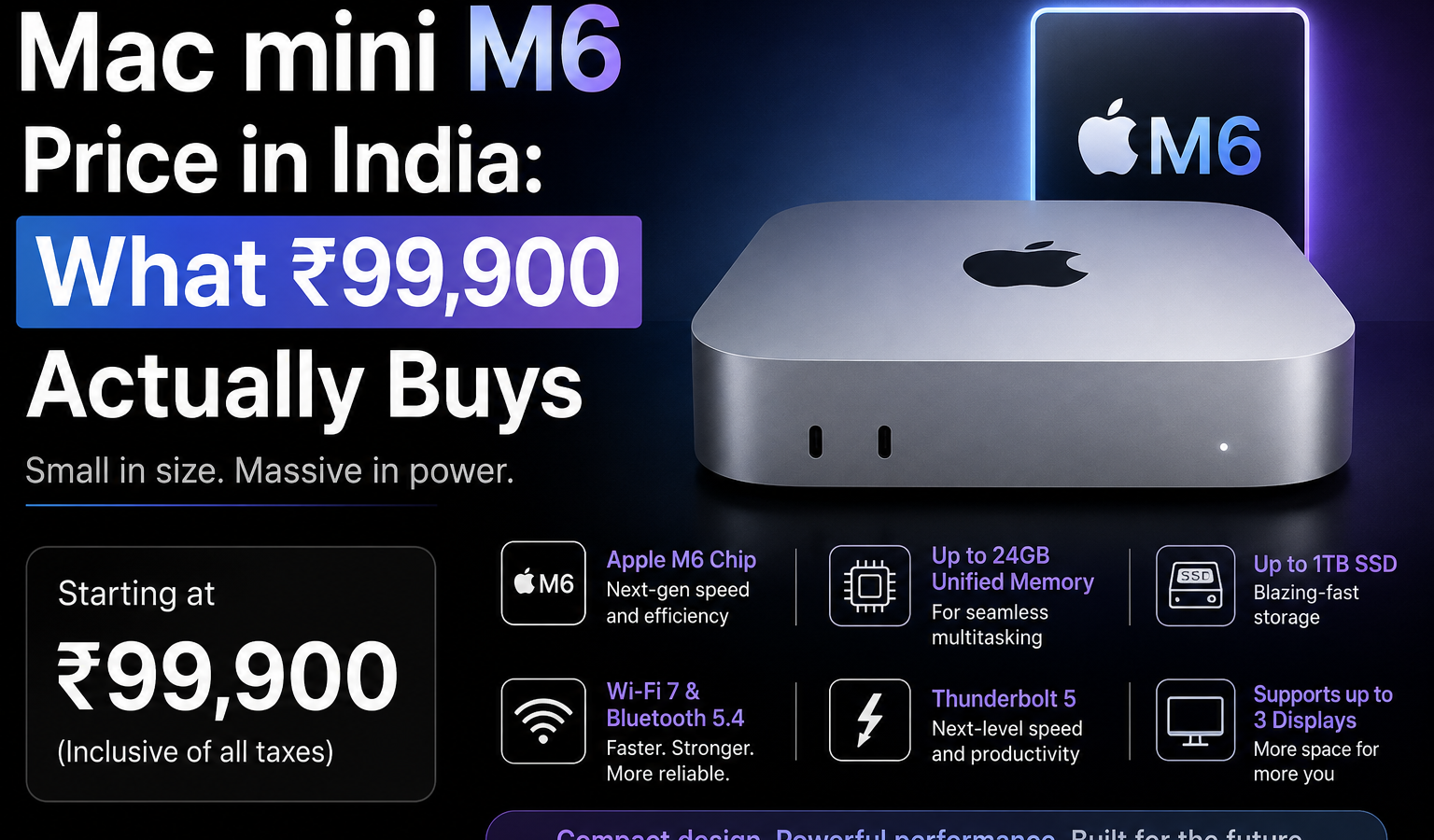
The Mac mini has always been the Mac you recommend to someone who does not want to spend money on a Mac. That is what it was for. In late 2024 it launched in India at ₹59,900, which was the cheapest Apple had ever asked for a desktop computer, and the recommendation wrote itself.
The M6 model announced on 25 August 2026 starts at ₹99,900. That is a ₹40,000 rise in under two years on a machine whose entire argument was that it was cheap.
The chip inside it is genuinely new — Apple’s first 2-nanometre processor, in the cheapest Mac in the range, before the MacBook Pro gets it. But the chip is not the story. The price is, and the reason for the price has almost nothing to do with Apple.
Contents
- What it costs in India
- Why it costs that much
- What is actually new
- The base configuration is the slow one
- M6 against M5 Pro, and the Neural Engine surprise
- Whether to buy one
- Questions people ask
What it costs in India
India was in the first wave of 30 countries. Pre-orders opened on 25 August 2026 and machines reach buyers from 22 September.
| Configuration | India | US |
|---|---|---|
| M6 — 12-core CPU, 12-core GPU, 16GB, 256GB | ₹99,900 | $899 |
| M5 Pro — 15-core CPU, 16-core GPU, 24GB, 512GB | ₹2,09,900 | $1,699 |
| M5 Pro — 18-core CPU, 20-core GPU, 24GB, 512GB | ₹2,33,900 | $1,899 |
| M6, education pricing | ₹88,900 | $799 |
| M5 Pro, education pricing | ₹1,97,900 | — |
The M4 model it replaces had itself already been raised to around ₹94,900 by the time it was withdrawn. Measured against that, the M6 is ₹5,000 more. Measured against what a Mac mini cost when this generation of the design launched, it is ₹40,000 more. Both numbers are true and they tell opposite stories, which is why the comparison you are shown depends on who is doing the showing.
Why it costs that much
Apple has been unusually direct about this. Announcing a round of Mac and iPad increases in June 2026, the company said it had “never seen a component price increase this much, this quickly”, and attributed it to the rapid expansion of AI data centres driving up demand for memory and storage chips across the industry.
The sequence over 2026 is worth laying out, because the ₹99,900 headline is the end of it rather than the whole of it.
- May 2026 — the $599 configuration with 16GB and 256GB is quietly discontinued. The $799 512GB model becomes the entry point. The sticker price never changed; the cheapest machine simply stopped existing.
- 25 June 2026 — an explicit increase. The M4 Pro mini goes from $1,399 to $1,599. Mac prices rise roughly 15–20% across the board, iPads 15–25%. The 16GB/256GB option returns.
- 25 August 2026 — the M6 mini arrives at $899, the highest starting price a Mac mini has ever carried.
This matters for how you read the machine. A price rise driven by memory and NAND costs is not a rise Apple can reverse with a generous configuration, and it shows up in what you get rather than only in what you pay. The base M6 ships with 256GB of storage in 2026 — the same amount the base mini shipped with in 2020.
What is actually new
The M6 is Apple’s first chip on a 2-nanometre process, and the Mac mini gets it before any other Mac — an inversion of the usual order, where the MacBook Pro or iPad Pro takes the new silicon first.
| Process | 2nm, a first for Apple silicon |
| CPU | 12-core — 2 super, 4 performance, 6 efficiency |
| GPU | 12-core, Neural Accelerators in every core |
| Neural Engine | Dual 16-core |
| Memory | 16GB standard, to 24GB or 32GB |
| Memory bandwidth | 153GB/s at 16GB, 170GB/s at 24GB and 32GB |
| Storage | 256GB standard, to 2TB |
| Ports | 3× Thunderbolt 4, HDMI, 2× USB-C front, headphone |
| Networking | Wi-Fi 7, Bluetooth 6, Thread, 2.5Gb Ethernet (10Gb optional) |
Against the M4, Apple claims up to 40% faster multithreaded CPU work, 4× faster AI performance, 2× faster graphics, 2× faster storage, 4.8× faster large-language-model processing in LM Studio, 1.5× faster spreadsheet recalculation and 2× the frame rate in Cyberpunk 2077. The AI and LLM figures are the ones doing real work here; the rest are the ordinary generational numbers.
The dual Neural Engine is the part with no precedent in a Mac mini. Two 16-core engines instead of one, paired with Neural Accelerators inside every GPU core, is a configuration aimed squarely at running models on the machine rather than calling out to a server.
The base configuration is the slow one
This is the detail most coverage has skipped, and it is the one that should decide what you order.
Memory bandwidth on the M6 is not fixed. The 16GB configuration runs at 153GB/s. Move to 24GB or 32GB and it runs at 170GB/s — the figure quoted in most of the launch coverage, and the figure the marketing comparisons are built on. The ₹99,900 machine is not the machine those numbers describe.
Bandwidth is the constraint that matters most for exactly the workload Apple is selling this chip on. A local language model is limited by how fast weights move out of memory, not by how fast the cores can multiply. Buying the base configuration to run local models means paying for a dual Neural Engine and then starving it, on a machine whose memory cannot be upgraded afterwards.
If the AI performance is why you are buying, the 24GB configuration is the entry point, not the 16GB one.
M6 against M5 Pro, and the Neural Engine surprise
Apple is selling two chip generations in the same enclosure this year, which is confusing on its face — the cheaper machine has the newer chip. The M5 Pro is the older architecture scaled up; the M6 is the newer architecture at the bottom of the range.
| M6 | M5 Pro | |
|---|---|---|
| CPU | 12-core | 15-core, to 18-core |
| GPU | 12-core | 16-core, to 20-core |
| Neural Engine | Dual 16-core | 16-core |
| Memory | 16GB, to 32GB | 24GB, to 64GB |
| Bandwidth | 153–170GB/s | 307GB/s |
| Thunderbolt | 4 (40 Gbps) | 5 (120 Gbps) |
| India price from | ₹99,900 | ₹2,09,900 |
Note the third row. The ₹99,900 machine has twice the Neural Engine of the ₹2,09,900 one. That is what buying a newer architecture gets you, and it means the usual advice — pay more if you do AI work — is wrong here in a specific way.
The M5 Pro still wins for large local models, but on bandwidth and capacity rather than neural silicon: 307GB/s and up to 64GB of unified memory will hold and feed a model the M6 cannot fit at all. It also brings Thunderbolt 5 at three times the throughput, which matters if you work off external storage. For CPU-bound and GPU-bound work — video encoding, 3D rendering, compilation — it wins straightforwardly on core count.
The dividing line is not “casual versus professional”. It is whether your work is limited by memory or by cores.
Whether to buy one
On an Intel mini or an M1. Yes, and without much deliberation. Two or more architectural generations, and in the Intel case a machine now outside macOS support. The price is worse than it was but the upgrade is real.
On an M4. No. A 40% multithreaded gain does not justify ₹99,900 nineteen months later. The exception is if you have started running local models seriously, where the dual Neural Engine and the 4.8× LM Studio figure are a different class of improvement — and in that case you want the 24GB configuration, not the base.
Buying a first desktop, for documents, browsing and video calls. This is where the price change genuinely bites. At ₹59,900 the mini was the obvious answer for a general-purpose desktop. At ₹99,900 it is a considered purchase, and a discounted M4 — while stock lasts — does everything in this list without any compromise you would notice.
For gaming. No. Twice the frame rate in one ray-traced title does not change what the macOS library is, and nothing about a ₹99,900 desktop is a sensible route into PC gaming.
If you can wait. Component costs are the stated cause of the rise and they are cyclical. Nobody can tell you when memory prices ease, but a machine priced by a supply shortage is not a machine that rewards buying at launch. There is no functional reason to pre-order this one.
Questions people ask
What is the Mac mini M6 price in India?
₹99,900 for the base configuration — 12-core CPU, 12-core GPU, 16GB of memory, 256GB of storage. The M5 Pro model starts at ₹2,09,900. Education pricing is ₹88,900 and ₹1,97,900. Apple’s press release gave US pricing only, so check the India store to confirm before ordering.
When is it available in India?
Pre-orders opened on 25 August 2026, with India among the 30 launch countries. Deliveries and retail availability begin 22 September 2026.
Why is the Mac mini so much more expensive than before?
Memory and storage chip prices. Apple raised Mac prices roughly 15–20% in June 2026, saying it had never seen component costs rise this fast, and blamed demand from AI data centre construction. The M6 mini’s ₹99,900 is the third step in a year of increases rather than a one-off decision about this model.
Is 16GB enough?
For ordinary desktop work, yes. For local AI models, no — and not only for capacity reasons. The 16GB configuration also runs at 153GB/s of memory bandwidth against 170GB/s at 24GB and 32GB, and memory cannot be added later.
M6 or M5 Pro?
The M6 has the better Neural Engine — dual 16-core against the M5 Pro’s single 16-core. The M5 Pro has more CPU and GPU cores, 307GB/s of bandwidth, up to 64GB of memory and Thunderbolt 5. Choose the M5 Pro for video, 3D, compilation or models too large for 32GB. Otherwise the M6 is the newer chip for less than half the money.
Should I buy a discounted M4 instead?
For general desktop use, it is the better value while stock lasts, and the difference will not be visible in browsing, documents or video calls. Buy the M6 if you specifically want the AI performance, which is the one area where the gap is large rather than incremental.
Has the design changed?
No. Same enclosure, same size, same finish. The rear carries three Thunderbolt 4 ports, HDMI and Ethernet, with two USB-C ports and a headphone jack at the front. Ethernet is 2.5Gb as standard and can be configured to 10Gb.
